
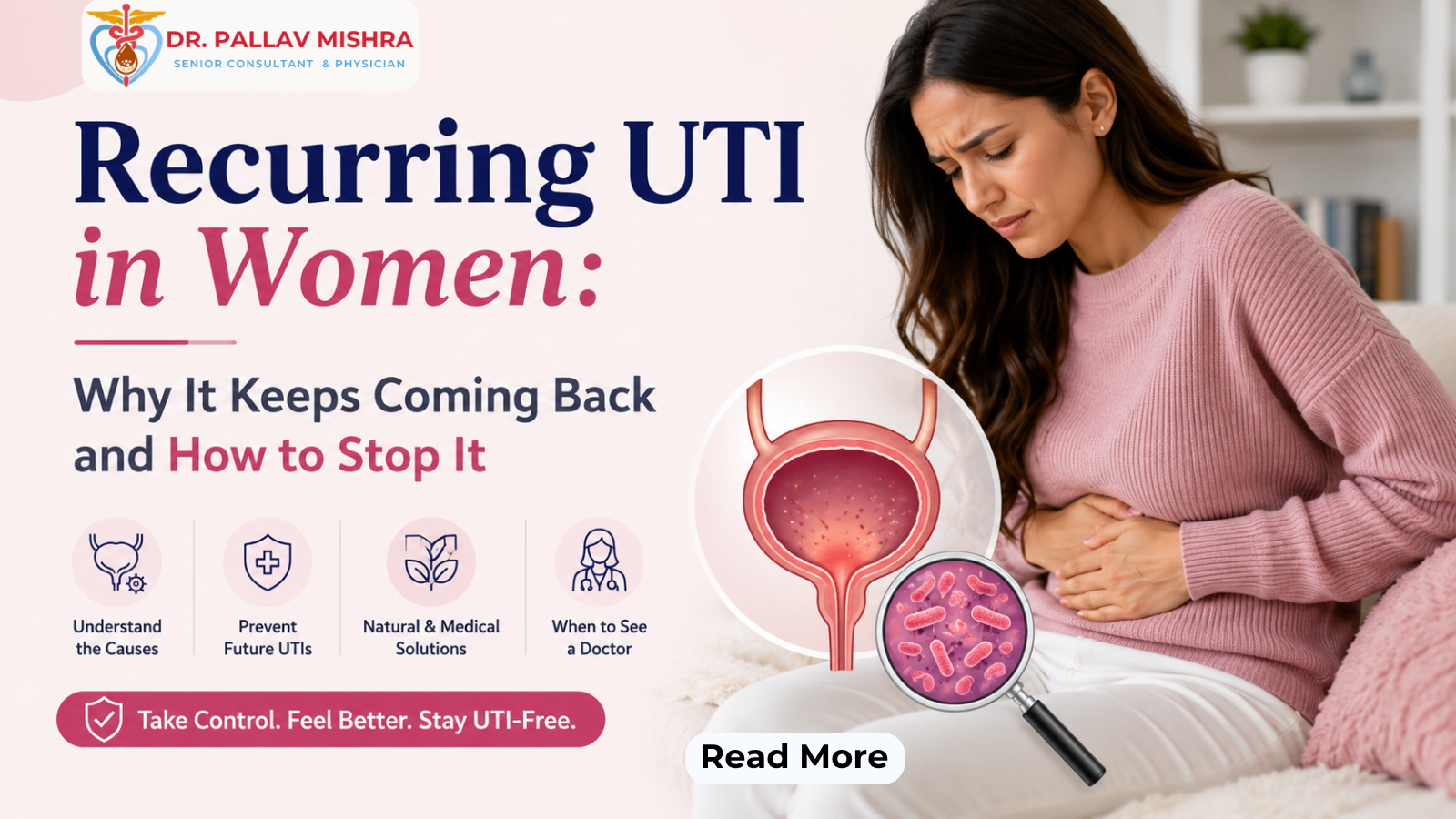
Recurring UTI in Women: Why It Keeps Coming Back and How to Stop It
Doctor:Dr. Pallav Mishra
SpecialistSenior Consultant Physician & Diabetologist
PlaceYatharth Super Speciality Hospital Noida, India
If you've ever dealt with a urinary tract infection, you know the drill — the burning, the constant urge to run to the bathroom, and that heavy, uncomfortable feeling low in your belly. Now imagine going through that not once, but every few weeks or months. For millions of women, this isn't a hypothetical — it's a frustrating, exhausting reality called recurrent UTI.
If you're tired of finishing one round of antibiotics only to feel symptoms creeping back a few weeks later, you're not alone, and more importantly, you're not out of options. Let's talk about why this keeps happening and what you can actually do about it.
What Counts as a "Recurring" UTI?
Doctors generally define a recurrent UTI as having two or more infections within six months, or three or more within a year. It's different from a single infection that just wasn't treated properly — this is your body genuinely getting infected again and again, sometimes with the same bacteria, sometimes with a different strain altogether.
Why Does It Keep Coming Back?
There isn't one single reason — it's usually a mix of biology, habits, and sometimes an underlying issue that hasn't been addressed yet.
1. Female anatomy makes it easier. Women have a shorter urethra than men, which means bacteria — most commonly E. coli from the digestive tract — have a much shorter distance to travel to reach the bladder. This is the single biggest reason UTIs are so much more common in women.
2. Incomplete treatment: One of the most common (and most avoidable) reasons for recurrence is stopping antibiotics the moment symptoms improve, instead of finishing the full course. This allows surviving bacteria to bounce back stronger.
3. Sexual activity: Intercourse can push bacteria toward the urethra, which is why UTIs are sometimes jokingly (but accurately) called "honeymoon cystitis." Not urinating after sex is a common, fixable trigger.
4. Hormonal changes: Menopause causes a drop in estrogen, which thins the vaginal and urinary tract lining and reduces protective bacteria. This is a major reason for recurrent UTIs in postmenopausal women.
5. Underlying conditions: Diabetes, kidney stones, a weakened immune system, or structural issues in the urinary tract can all make infections more frequent and harder to clear. Sometimes what looks like a "stubborn UTI" is actually your body flagging something else that needs attention.
6. Poor hygiene habits or holding urine too long: Wiping back to front, holding in urine for long stretches, or not drinking enough water all allow bacteria more time to multiply.
Signs Your UTI Might Be More Than "Just a UTI"
It's easy to shrug off recurring UTIs as bad luck, but persistent infections deserve a proper medical evaluation rather than repeated over-the-counter fixes. Watch for:
Fever or chills along with urinary symptoms
Blood in urine
Lower back or side pain (a sign infection may be reaching the kidneys)
Symptoms that return within days of finishing antibiotics
Cloudy or strong-smelling urine that doesn't improve
If any of this sounds familiar, it's genuinely worth booking a proper consultation instead of self-medicating again. Many women are searching for the Best General Physician in Noida. Do so precisely because their UTIs kept relapsing despite multiple pharmacy visits — and a thorough evaluation made all the difference.
How to Actually Break the Cycle
The good news: recurrent UTIs are very manageable once the root cause is identified.
Stay properly hydrated — Water helps flush bacteria out of the urinary tract before it has a chance to settle in.
Never hold urine for long periods — Try to urinate every 3–4 hours, and always go after sex.
Wipe front to back — A simple habit that significantly reduces bacterial transfer.
Reassess your birth control — Diaphragms and spermicides are linked to higher UTI recurrence in some women; your doctor can suggest alternatives.
Consider cranberry or probiotic supplements — Evidence is mixed, but many women find they help as a preventive measure alongside, not instead of, medical treatment.
Get a urine culture, not just a dipstick test — This identifies the exact bacteria and the antibiotic it actually responds to, instead of guessing.
Ask about low-dose preventive antibiotics or vaginal estrogen — For frequent recurrences, especially post-menopause, doctors sometimes recommend a low-dose preventive course or topical estrogen therapy.
Treat the whole picture, not just the infection — If you also keep catching seasonal colds or coughs alongside urinary symptoms, it usually means your overall immunity needs attention. This is where consulting the Best Cold & Cough doctor near Noida. alongside your general physician, can help address both issues together rather than treating each flare-up in isolation.
When to See a Doctor
If you've had two or more UTIs in six months, don't just keep repeating the same antibiotic course. A proper diagnostic workup — urine culture, sometimes an ultrasound, and a review of your lifestyle and hormonal status — can uncover the real trigger. Patients across Noida frequently turn to the Best General Physician in Noida. for exactly this kind of detailed, personalized evaluation rather than one-size-fits-all treatment. Similarly, if recurring infections are paired with respiratory symptoms, the Best Cold & Cough doctor near Noida can help rule out any connected immune-related cause.
The Bottom Line
Recurring UTIs are common, but they are not something you simply have to "live with." With the right combination of daily habits, timely medical evaluation, and — when needed — targeted treatment from the Best General Physician in Noida. or the Best Cold & Cough doctor near Noida. Most women can break the cycle for good. Don't wait for the fourth or fifth infection to take it seriously — your body is telling you something, and it's worth listening to.
FAQs
1. How many UTIs count as "recurrent"? Two or more in six months, or three or more in a year.
2. Can recurring UTIS damage my kidneys? Untreated or frequent infections can spread to the kidneys, so timely treatment matters.
3. Do cranberry supplements really help? They may reduce frequency for some women, but they aren't a replacement for medical treatment.
4. Is recurrent UTI linked to menopause? Yes, lower estrogen levels after menopause increase UTI risk significantly.
5. Should I see a doctor after every UTI? For occasional infections, not always — but recurring ones need a proper evaluation.
